How to discipline a child without yelling or hitting (ages 3 to 12)
How to discipline a child without yelling or hitting: a calm toolbox, the exact words to say instead of shouting, and what works at ages 3 to 12.
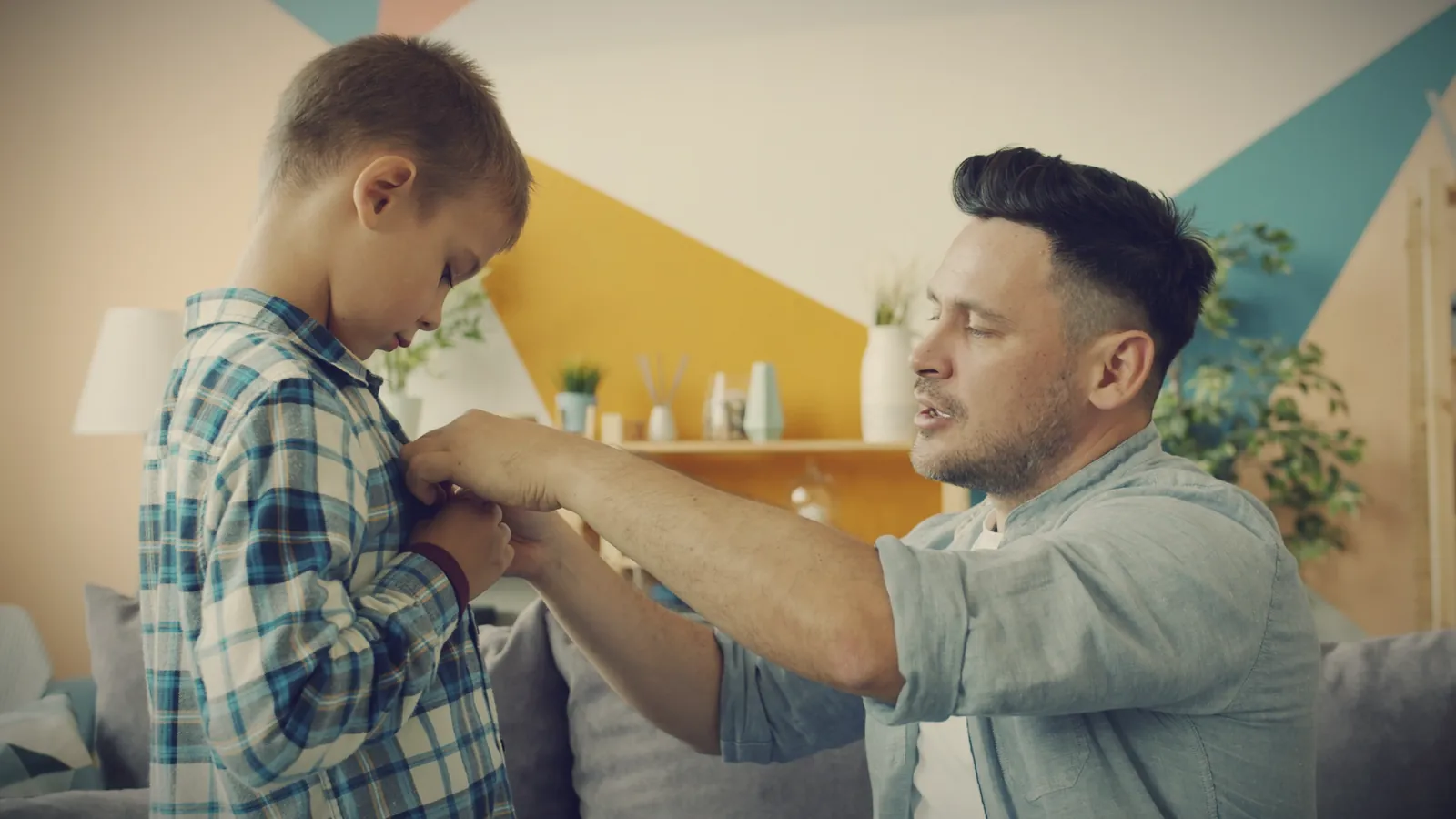
It's 6:40 pm. Someone has hit their brother, someone else has said "you can't make me", and you hear your own voice getting louder than you ever meant it to. Later, you lie awake wondering how to discipline a child without becoming the shouting parent you promised yourself you'd never be.
You're not failing. Most of us were told what not to do (don't yell, don't spank) and never shown what to do instead. That's what this page is for: a small toolbox, the exact words to use at each age, and links to deeper help for the hardest situations.
Discipline means teaching, not punishing
The word "discipline" comes from the Latin for teaching and learning, the same root as "disciple". That's worth remembering when you're angry: the goal isn't to make a child pay, it's to help them do better next time.
Punishment asks "how do I make this stop right now?" Discipline asks "what does my child need to learn so this happens less?" Usually the answer is a skill: waiting, accepting a no, calming down, saying "I'm furious" instead of hitting.
That doesn't mean no limits. Calm discipline is kind and firm: the limit holds, and nobody is humiliated.
Why kids push limits
- Self-control is still under construction. A five-year-old can know the rule and still not manage it when angry.
- Big feelings, few words. When a child can't say "I'm jealous" or "I'm exhausted", it comes out as hitting, shouting or a flat refusal.
- They're checking the limit is real. If "no" sometimes turns into "yes" after enough protest, protesting is a smart strategy from a child's point of view.
- Tired, hungry, overloaded. The hour before dinner is hard for everyone. Many battles are really about fuel or rest.
- They want connection. On busy days, negative attention still counts as attention.
Ways to discipline a child: the calm toolbox
You don't need everything at once. Pick two or three tools that fit your family and use them the same way every time.
1. A few rules, said positively
Three to five house rules, phrased as what to do: "We use gentle hands." "We speak kindly, even when we're angry." "Screens stay off at dinner." A child can't follow a rule they can't remember.
2. Connection before correction
Get close, at eye level, and name what you see before you correct it: "You really wanted the blue cup." A child who feels understood has less to fight about. This isn't giving in: the limit comes right after.
3. Choices inside the rule
"Bath now, or after one more page?" "Walk to the car, or hop like a frog?" The rule doesn't move, but your child gets to decide something.
4. "When… then"
"When your shoes are on, then we go to the park." It replaces a flat no with a way forward (see the "yes, when…" habit).
5. Natural and logical consequences
A natural consequence happens on its own: no coat, a chilly walk (only when it's safe). A logical consequence is one you set, linked to the behavior and announced calmly: "The markers go away for today, because they went on the wall."
Keep them small and immediate. And one line from the American Academy of Pediatrics worth keeping in mind at dinner: never take away something a child truly needs, such as a meal.
6. A calm-down break, or time-in
A child in full meltdown can't take in a lesson. With little ones, stay close: "I'm here. We'll talk when your body is calm." Older kids can pick their own calm spot. If you use time-outs, the same AAP page suggests keeping them short, about one minute per year of age.
7. Describe the good act
Catch them getting it right, and say exactly what they did: "You were angry and you used words, not hands. That was hard." Precise praise tells a child what to repeat (descriptive praise).
8. Repair after conflict
Once everyone is calm, talk it through: what happened, how did it feel, what can we do now? When you're the one who lost it, go first: "I yelled. I'm sorry. Next time I'll take a breath first." See how to apologize to your child.
How to discipline a child without yelling or hitting: say this instead
These swaps keep the limit and lose the volume. Say them slowly, at eye level, a little quieter than usual.
- Instead of "How many times do I have to tell you?!" Say: "Shoes on now. I'll wait right here."
- Instead of "Stop hitting your sister!" Say: "I won't let you hit. Hands down. You can stomp your feet or squeeze this cushion."
- Instead of "That's it, no TV for a week!" Say: "The TV is off for today. You can try again tomorrow."
- Instead of "Don't you dare talk to me like that!" Say: "I want to hear what you think. Say it again in a calm voice."
- Instead of "Stop crying, it's not a big deal." Say: "You're really upset. I'm right here."
- Instead of "Because I said so!" Say: "The answer is no. You can be cross about it, and you can ask me why after dinner."
- Instead of "You're impossible tonight." Say: "This is a hard evening. Let's start again."
- Instead of "We're never coming to the park again!" Say: "If sand gets thrown again, we'll leave the sandbox." Then do it, kindly.
How to discipline a child that doesn't listen
When requests bounce off, more words rarely help. Try this sequence:
- Get close, use their name, wait until they look at you.
- Say it once, short and positive.
- Follow through with action, not repetition: walk over, switch off the screen kindly, take their hand.
Getting heard the first time is a skill of its own: see how to get kids to listen without yelling.
How to discipline a child at home, age by age
Ages 3 to 5
Few words, lots of physical help. At this age, discipline mostly means stopping the behavior gently and showing what to do instead.
- Say: "Gentle hands. I'll help you."
- Say: "Feet on the floor, or I'll help you down."
Use choices, distraction and short time-ins. Expect to teach the same lesson many times: that's normal, not failure.
Ages 6 to 9
Children this age understand rules and care a lot about fairness. Make the rules together, use "when… then", and agree on consequences in advance so nothing comes out of the blue.
- Say: "What's our rule about screens at dinner?"
- Say: "You think it's unfair. Tell me why, calmly, and I'll really listen."
After a hard moment, make a plan together: "What could you do next time you feel this angry?"
Ages 10 to 12
Pre-teens want a say and hate being lectured, especially in front of siblings. Correct in private, keep it short, and negotiate what can be negotiated.
- Say: "I'm not going to argue now. Let's talk after dinner, just us."
- Say: "Phones go off at nine. What's your plan to finish before then?"
Give them a real voice in the house rules. A pre-teen who feels heard has less to push against.
Gentle parenting: kind, and still firm
If you've searched how to discipline a child with gentle parenting, you may worry it means no consequences. It doesn't. Gentle discipline is warm in tone and steady on limits: you name the feeling, keep the rule and follow through. When it seems not to work, the missing piece is usually a limit that actually holds, every time.
Over the next few weeks: prevention beats punishment
- Protect the hard hours. A snack after school, a warning before every transition, an earlier bedtime on rough weeks.
- Give each child a few minutes of one-on-one time every day. They choose the activity; you don't correct or teach. It fills the attention tank that misbehavior would otherwise try to fill.
- Practice skills when everyone is calm. Role-play waiting, asking, losing a game. A skill rehearsed on a calm Tuesday is easier to reach for on a stormy Friday.
- Look after yourself. Staying calm is far easier when you've eaten and slept.
What doesn't work, and why
- Yelling. It may stop the behavior for a minute, but children learn to tune it out or yell back. The AAP notes that yelling and words meant to shame children are ineffective and harmful.
- Spanking or hitting. The AAP recommends that parents do not spank, hit or slap children, and links physical punishment with more aggression (AAP: where we stand on spanking). It also teaches the very thing you're trying to stop: that big feelings are solved with hands.
- Shaming, especially in front of others. Humiliation makes children defensive, not sorry.
- Threats you won't carry out. "No birthday party!" teaches that your warnings are just noise.
- Huge, long punishments. A week without everything leaves a child with nothing left to lose.
Specific situations
These guides go deeper on the hardest moments:
- Defiant child. When every request turns into "no": what's behind defiance and how to step out of the tug-of-war.
- My child is out of control. For the days you feel you've lost the reins: a calm plan to start today, safety first.
- When your child doesn't care about consequences. If punishments have stopped working, why that happens and what to use instead.
- Why kids act out only at home. Fine at school, a storm at home? Why the safest parent often gets the meltdown, and how to make evenings easier.
- Behavior charts for kids. How to build a reward chart that doesn't fizzle out after two weeks.
- My child hits me. If you're looking for how to discipline a child who hits, start here: what to do in the moment, and how to repair afterwards.
- How to get kids to listen without yelling. About being heard the first time, where this page is about setting limits.
- Kids talking back. How to answer eye-rolls and "you can't make me", and teach respectful disagreement instead.
- Tantrums at dinner time. What to do when a meal turns into a meltdown, and how to make the next one less likely.
When to talk to a professional
Calm discipline takes weeks, not days. But some signs mean it's worth getting help sooner:
- Someone is getting hurt: your child often hurts others, themselves or animals, or breaks things on purpose.
- Outbursts happen most days, last a long time, or haven't eased after several weeks of steady, calm effort.
- It's affecting school, friendships or family life (everyone tiptoeing around the next explosion).
- You feel you might lose control and hurt your child, or you're overwhelmed most days.
If anyone is in danger right now, call your local emergency number. Otherwise, start with your pediatrician or family doctor. They can look at sleep, health and development, check whether something else is going on, and point you to the right support. Asking for help is part of the job, not proof you've failed.
Practice the skills at the dinner table
Most of what discipline teaches (waiting, listening, accepting a no, disagreeing without shouting) is hard to learn in the middle of a meltdown. It's easier to practice in a calm, daily, low-stakes moment, and dinner is often the only one families have.
Kalmdix is a voice companion you put on the table: tap Start, and it talks with everyone, gives each person a turn by name and hosts short conversation games. In Educate, you choose one habit, such as waiting your turn to speak or disagreeing respectfully, and Kalmdix turns it into a playful mission over five meals, so nobody has to nag. It never says who did or didn't do it, and never lectures. You can also set a private goal for yourself, like lowering your voice, which it never mentions at the table. It isn't therapy and doesn't replace you: it's a calm place to practice.
Frequently asked questions
What's the best way to discipline a child?
There's no single trick, but calm, consistent limits work better for most children than harsh punishment. Keep a few clear rules, connect before you correct, use small consequences linked to the behavior, and point out what your child does well. The American Academy of Pediatrics recommends this kind of teaching discipline over spanking or yelling.
Is it OK to spank a child?
The American Academy of Pediatrics recommends that parents do not spank, hit or slap children, and links physical punishment with more aggression in children. If you have spanked before, you can change course today: stop the behavior calmly, use a short calm-down break, and follow up with a small, related consequence.
How do you discipline a child who hits?
Stop the hit calmly and firmly ("I won't let you hit"), move out of reach, and wait until everyone is calm. Then teach what angry hands can do instead, like stomping or squeezing a cushion, and repair together. Hitting back or spanking teaches the opposite lesson.
Does gentle parenting mean no consequences?
No. Gentle discipline is warm in tone but still has limits that hold: you name the feeling, keep the rule and follow through with a small, related consequence when needed. What it leaves out is yelling, shaming and physical punishment.
Bring Kalmdix to your next family dinner
Put your phone on the table and tap Start: Kalmdix hosts the conversation, gives everyone a turn and keeps it fun. Plans from €9.99 a month, cancel anytime.
About the author
The Kalmdix team — Kalmdix. The people behind Kalmdix, the AI voice companion that sparks conversations and teaches good manners through play at the family dinner table.